
Winter brings the serene beauty of white landscapes, cozy nights by the fire, and the inevitable dread of the morning driveway clearance. For decades, the traditional snow shovel has been a staple in garages across the Northern Hemisphere. However, the motion of scooping, lifting, and throwing heavy, wet snow is a leading cause of winter-related back injuries and cardiac stress.
Enter the snow pusher. Unlike traditional shovels designed for lifting, snow pushers are engineered to act like manual plows. They utilize your body weight and leg strength to glide snow out of the way, keeping the shovel blade on the ground and your back straight.
In this comprehensive guide, we are reviewing three of the top-rated snow pushers currently dominating the market. We will explore the mechanics of efficient snow removal, break down the features of these specific tools, and help you decide which one is the perfect companion for the next blizzard.
![[artistly design] 019be259 04fa 7259 83d5 6ae00cfa5af6](https://cozylivingguide.com/wp-content/uploads/Artistly-Design-019be259-04fa-7259-83d5-6ae00cfa5af6-1024x427.png "The Ultimate Guide to Snow Pusher Shovels: Clear Your Driveway Without the Back Pain")
Why Switch to a Snow Pusher?
Before diving into the specific products, it is essential to understand the fundamental shift in mechanics between a standard shovel and a pusher.
The Physics of Removal
A traditional shovel requires you to act as a lever. The fulcrum is your lower back. When you lift ten pounds of wet snow at the end of a five-foot pole, the force exerted on your lumbar spine is multiplied exponentially. This is why “shoveler’s back” is such a common ailment.
A snow pusher, conversely, relies on linear force. You hold the handle at chest or hip height and walk forward. The blade scrapes the pavement, accumulating snow as you go. When you reach the edge of the driveway, you simply tilt the handle to dump the load. There is zero lifting involved during the transport phase.
Efficiency and Speed
Snow pushers generally feature wider blades than scoops—typically ranging from 24 inches to 36 inches or more. This allows you to clear a two-car driveway in significantly fewer passes. While a pusher might struggle with 2 feet of fresh powder in a single pass (unless you take layers), they are the undisputed kings of 1-6 inch snowfalls, which constitute the majority of winter storms for most regions.
Top Contenders for 2024
We have selected three high-performance tools that promise to transform your winter chores. These models focus on ergonomics, durability, and blade efficiency.
1. The Heavy-Duty Choice: YEITSNOW Ergonomic Reinforced Pusher
This tool is designed for the homeowner who views snow removal as a serious mission. It combines robust construction with a user-friendly design meant to tackle larger surface areas.

- Ergonomic Design: The innovative curved Z-shape handle minimizes back strain and bending, allowing for comfortable, upri…
- Lightweight Yet Durable: Crafted from high-quality poly material, the shovel head is exceptionally light for easy handli…
- Reinforced for Heavy Duty: Strengthened handles is engineered with improved steel delivering superior strength and fract…
Design and Build Quality
The YEITSNOW model stands out due to its reinforced structure. Many budget shovels fail where the handle meets the blade—the point of highest stress. This model addresses that weak point with reinforced bracketing. The blade is typically constructed from high-impact polypropylene, a material chosen for its ability to withstand freezing temperatures without becoming brittle and cracking.
Performance on the Driveway
The “pusher” designation here is key. The curvature of the blade is optimized to roll the snow forward. As you push, the snow curls over itself, creating a rolling log of snow ahead of the blade. This rolling action reduces friction and the effort required to move forward.
This unit is particularly effective on asphalt and concrete. The blade edge is sharp enough to scrape down to the pavement, removing that thin layer of hard-packed snow that can turn into ice if left behind.
Ergonomics
The handle geometry is the star feature. It is designed to reduce the need for bending. By allowing you to keep an upright posture, it engages your glutes and hamstrings—your body’s powerhouse muscles—rather than your delicate lower back stabilizers.
2. The Precision Master: 24-Inch Aluminum Edge Pusher
For those with medium-sized driveways or walkways that require a bit more maneuverability, this 24-inch model offers a perfect balance of width and control.
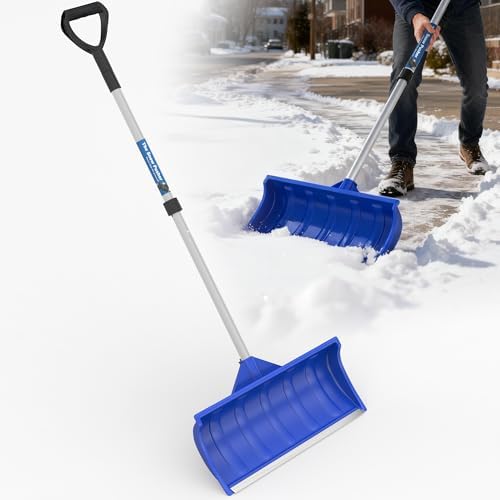
- Snow Pusher Removal Quickly: Rapid Snow Clearance with Wide Blade Boasting a 24 inch shovel blade, 54 inch height, you c…
- Ergonomic Handle Design: The comfortable handle of snow pusher shovel will help you reduce muscle strain or back injury …
- Suitable for Most Occasion: The snow plow shovel has sufficient length and width to increase the area of snow removal, i…
The Aluminum Advantage
This model features an aluminum wear strip on the leading edge of the blade. This is a critical feature for two reasons:
- Durability: Concrete acts like sandpaper on plastic. Without a wear strip, a plastic blade will wear down and become uneven over a few seasons. The aluminum edge extends the life of the tool significantly.
- Ice Cutting: Plastic blades often ride over patches of ice or hard-packed snow. The aluminum edge acts like a chisel, helping to scrape stubborn patches off the driveway surface.
Maneuverability
At roughly 24 inches wide, this pusher is in the “Goldilocks” zone. It is wide enough to clear a sidewalk in one or two passes, but narrow enough to fit through garden gates or navigate around parked cars without scratching them. It is lighter than the massive rolling pushers, making it easier to lift if you do need to toss snow over a snowbank.
Grip and Handling
The ergonomic handle usually features a D-grip. The D-grip is superior to a straight pole because it prevents the handle from twisting in your hand when you hit an uneven crack in the pavement. It allows you to apply torque and steer the shovel effectively.
3. The Sidewalk Specialist: Compact Ergonomic Pusher
Sometimes, bigger isn’t better. For front walks, steps, and clearing tight areas like doorways or decks, this model provides the agility required.
Optimized for Tight Spaces
Attempting to use a massive 30-inch snow pusher on a 36-inch front walk is frustrating. One slip and you are gouging the landscaping or banging into the porch railing. This model is streamlined for these exact scenarios. It allows for surgical snow removal, cleaning right up to the edges of doorframes and stairs.
Lightweight Design
Because it uses less material, this shovel is incredibly lightweight. This makes it an excellent choice for seniors or individuals with limited upper body strength. It reduces the fatigue factor significantly, allowing you to work longer without getting tired.
Versatility
While it is a “pusher,” the smaller blade size usually allows this tool to double as a scoop when necessary. If the snowplow leaves a heavy berm at the end of your driveway, you can use this shovel to lift and toss the chunks that are too heavy to push.
Detailed Buying Guide: What to Look For
When shopping for the perfect snow pusher, don’t just grab the first one you see at the hardware store. Consider these critical factors to ensure you get a tool that lasts.
1. Blade Material: Poly vs. Metal
- Polypropylene (Plastic): The most common material for pushers. It is lightweight and snow doesn’t stick to it as easily as metal. It is also gentle on delicate surfaces like wooden decks or stamped concrete.
- Metal (Steel/Aluminum): Extremely durable but heavy. Snow tends to stick to cold metal, requiring frequent waxing or spraying with cooking spray.
- Hybrid: The best option is often a poly blade with a metal wear strip (like product #2 and #3 above). You get the lightweight, non-stick benefits of plastic with the cutting power of metal.
2. Handle Ergonomics
Look for handles with a bend or an offset design. “Bent shaft” shovels are scientifically proven to reduce back strain by allowing the user to stand straighter. However, they can be awkward to lift and throw with. Since pushers are primarily for pushing, a bent handle is often a great feature.
3. Blade Width
- 18-21 Inches: Ideal for walkways, decks, and lifting.
- 24-26 Inches: The standard for most driveways. Good balance of speed and weight.
- 30+ Inches: Commercial grade. Great for large, flat driveways, but requires significant physical strength to push if the snow is wet and heavy.
4. Assembly and Repair
Check the connection point between the handle and the blade. This is the failure point for 90% of shovels. Look for bolts rather than screws or rivets. Bolts can be tightened if they work loose; rivets cannot. The YEITSNOW model (Product 1) emphasizes reinforced assembly, which suggests a focus on longevity.
The Technique: How to Use a Snow Pusher Correctly
Even the best tool won’t save your back if you use it incorrectly. Here is the pro-method for using your new equipment.
The Center-Out Method
If you have a wide driveway, don’t just push snow from one side to the other. You will end up with an unmanageably heavy pile by the time you reach the far side.
- Start in the center of the driveway.
- Push a line of snow to the right edge.
- Return to the center and push a line to the left edge.
- Work your way down the driveway.
This method ensures you are never pushing more than half the driveway’s width of snow at once.
The Angle Attack
If your shovel is straight (not a diagonal plow), you must create the angle yourself. Turn your body slightly so the blade attacks the snow at an angle. This allows the snow to slide off the side of the blade as you walk, rather than piling up in front of it. This creates a continuous windrow of snow and keeps the resistance low.
Handling “Heart Attack Snow”
Wet, heavy slush is dangerous. Do not try to push a full blade of slush. Take “half bites”—only use half the width of the shovel. It takes twice as many passes, but it keeps the resistance manageable and protects your heart and back.
Maintenance: Keep Your Pusher Gliding
To ensure your investment lasts for many winters:
- Tighten Hardware: Before the first snow, check all bolts and nuts. The vibration of scraping concrete loosens them over time.
- Wax the Blade: Apply car wax or even cooking spray to the blade surface. This prevents wet snow from sticking and weighing down the shovel.
- Store Indoors: Sunlight (UV rays) breaks down plastic over time, making it brittle. Store your shovel in the garage or shed, not leaning against the side of the house exposed to the sun.
- File the Edge: If the metal wear strip gets jagged from hitting rocks, use a metal file to smooth it out. A smooth edge clears snow better than a jagged one.
Conclusion: Which One Should You Buy?
Choosing between the YEITSNOW Reinforced Pusher, the 24-Inch Aluminum Edge, and the Compact Ergonomic model depends on your property and physical capability.
- Choose the YEITSNOW (Product 1) if you have a large, double-wide driveway and want to move maximum snow in minimum time. Its reinforced build suggests it can handle the torque of heavy pushing.
- Choose the 24-Inch Aluminum Edge (Product 2) if you need a versatile all-rounder. It is tough enough for the driveway but nimble enough for the sidewalk. The wear strip makes it the best choice for dealing with icy patches.
- Choose the Compact Ergonomic (Product 3) if you have intricate landscaping, narrow paths, or if you simply want the lightest tool possible to reduce fatigue.
Winter is inevitable, but the pain of clearing it doesn’t have to be. By upgrading from an old-fashioned scoop to a modern, ergonomic snow pusher, you are investing in your health and reclaiming your time. Equip yourself with the right tool now, before the first flakes begin to fall.